What Keeps Relationship OCD Going?
7 min Read

Understanding the cycle of Relationship OCD and why doubts keep returning.
"Why do I keep having the same doubts about my relationship?"
"Why can't I stop thinking about it?"
"Why does the uncertainty keep coming back, even after I've spent hours trying to figure it out?"
For many people struggling with Relationship OCD (ROCD), these questions can feel painfully familiar. They may spend large amounts of time analyzing their feelings, reviewing memories, comparing their relationship to others, seeking reassurance, or trying to determine whether they are in the "right" relationship. Yet despite these efforts, their doubts often return.
This can feel confusing. After all, if someone is investing so much energy trying to solve the problem, shouldn't they be getting closer to an answer?
Paradoxically, one of the reasons ROCD persists is that the very attempts to resolve relationship-related doubts may unintentionally reinforce them.
To understand why this happens, it helps to look at the obsessive-compulsive cycle that underlies ROCD.
The ROCD Cycle
Like other forms of OCD, ROCD is maintained by a recurring cycle involving thoughts, emotions, and behaviors that reinforce one another over time.
Although the cycle can vary somewhat from person to person, it often follows a similar pattern:
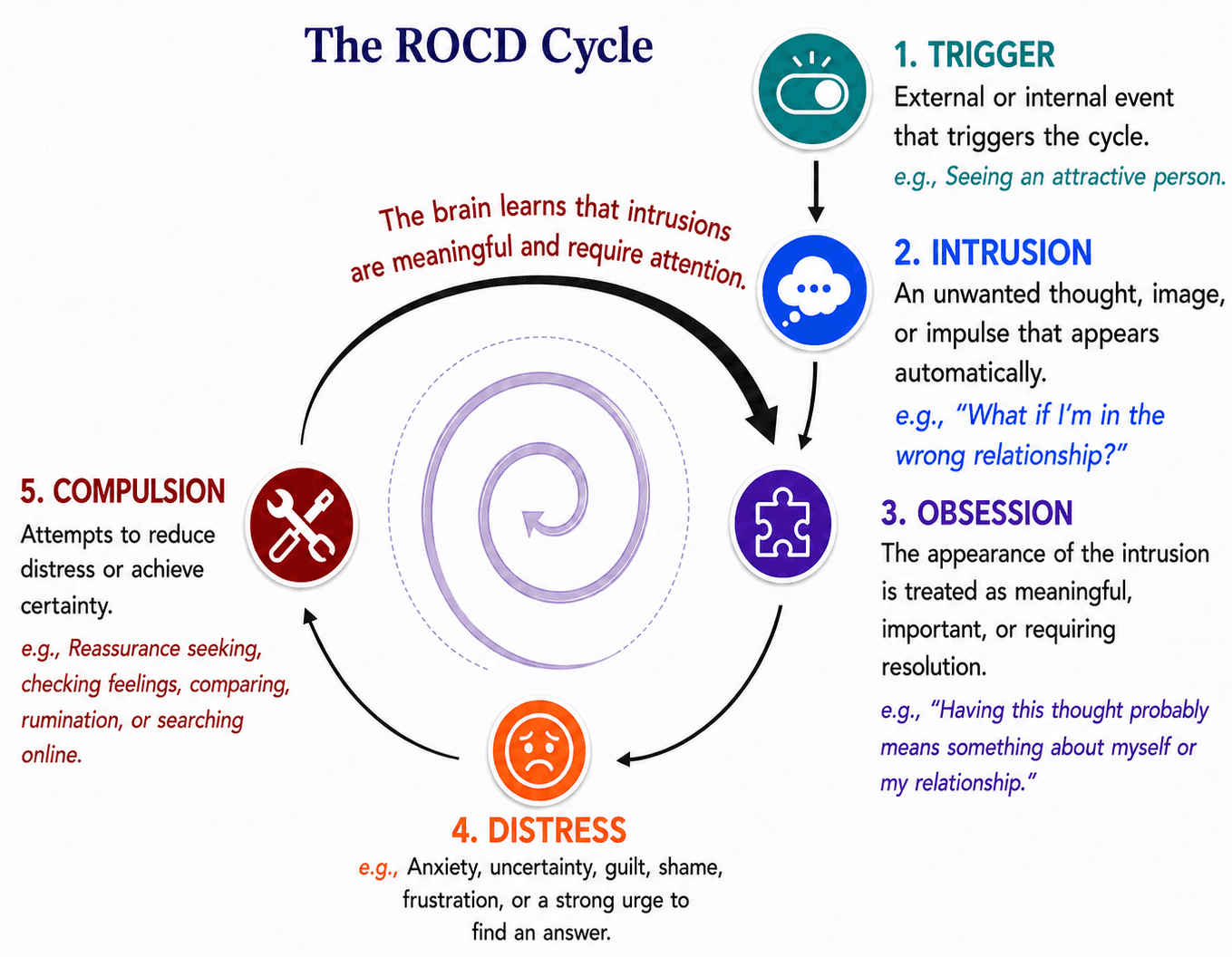
Understanding the different parts of the cycle can help explain why relationship doubts become so persistent and difficult to let go of. It can also provide an important first step toward effective coping.
Triggers
The cycle often begins with a trigger.
Triggers can be external, such as seeing another couple interact, meeting someone with desirable qualities, watching a romantic movie, or discussing commitment and relationships. They can also be internal, such as emotions, memories, bodily sensations, boredom, or periods of stress.
Sometimes people can clearly identify what triggered their doubts. At other times, the cycle appears to begin without any obvious trigger.
Intrusions: Thoughts That Appear Uninvited
Most people occasionally experience unwanted thoughts, doubts, images, or impulses that enter their minds automatically.
In relationships, these may include thoughts such as:
"What if I'm in the wrong relationship?"
"Maybe I don't love my partner enough."
"What if there is someone better for me?"
Although these thoughts can be unpleasant, experiencing them is a normal part of being human. People without ROCD often experience similar relationship-related doubts from time to time and move on without engaging with them every time they arise.
Intrusive thoughts are largely automatic. People do not choose to have them, and they often occur whether they want them to or not.
When an Intrusion Becomes an Obsession
One of the most important features of ROCD is that the appearance of intrusive thoughts is often treated as highly meaningful.
Rather than experiencing a thought as simply a passing mental event, people may begin to interpret its appearance as important information about themselves, their partner, or their relationship.
For example, an intrusive thought such as:
"Maybe I should leave my partner."
may quickly become:
"The fact that I had this thought probably means something is wrong with me or with my relationship."
This distinction is important.
Intrusions and obsessions are often better understood as different points along a continuum rather than as entirely separate categories. While most people experience relationship-related intrusions from time to time, people with ROCD tend to experience them more frequently, find them more distressing, and attach greater significance and meaning to their appearance.
Distress
Obsessions are often accompanied by intense emotional discomfort.
People with ROCD may experience anxiety, distress, uncertainty, guilt, shame, frustration, or a persistent sense that something is not quite right. They may also feel a strong urge to resolve the doubt as quickly as possible.
These feelings can be deeply uncomfortable.
Naturally, most people want relief from them.
Unfortunately, it is often the search for relief that fuels the next part of the cycle.
Compulsions
When faced with relationship-related distressing doubts and uncertainty, people with ROCD often respond with compulsions (also known as rituals).
Compulsions are attempts to reduce distress, gain certainty, or eliminate unwanted thoughts and feelings.
Importantly, compulsions are not defined by the behavior itself, but by the function they serve. Discussing a relationship with a friend is not necessarily a compulsion. However, the same conversation may function as a compulsion if its primary purpose is to urgently reduce distress, obtain reassurance, or achieve certainty about a distressing doubt.
In ROCD, compulsions can be overt or covert. Overt compulsions are visible behaviors such as seeking reassurance from others or searching online for answers. Covert compulsions take place internally and may include monitoring one's feelings, comparing the relationship to others, or continuously reviewing relationship-related questions in an attempt to reach certainty.
Although these behaviors differ from one person to another, they often serve a similar purpose: trying to achieve certainty about the relationship and make the distress go away.
At least temporarily.
Why Compulsions Keep the Cycle Going
This is where the cycle becomes self-perpetuating.
Compulsions often provide short-term relief. For a few minutes or hours, people may feel calmer, more certain, or reassured.
However, every time a person responds compulsively, the brain receives a powerful message:
"This doubt is important."
"This uncertainty requires attention."
"This problem must be resolved."
As a result, relationship-related doubts become increasingly salient.
People become more likely to notice them, look out for them, and react to them whenever they arise. When the doubts return, they often feel more significant, more threatening, and more urgent than before.
The person then responds with more checking, more analysis, more reassurance seeking, and more attempts to achieve certainty.
Although these efforts are understandable, they unintentionally strengthen the very process they are trying to escape.
Over time, people can become trapped in an exhausting pattern of repeatedly trying to solve questions that never feel fully resolved.
Breaking the Cycle
Understanding the cycle also helps explain how it can begin to change.
Triggers often occur automatically and uncontrollably.
Intrusive thoughts arise automatically.
Emotions and feelings of uncertainty are also not fully under voluntary control.
What can change is how people respond to these experiences.
Rather than treating every doubt as a problem that requires immediate analysis or resolution, treatment focuses on helping people reduce compulsive attempts to achieve certainty and eliminate distress. As people become less reactive to intrusive thoughts and uncertainty, the cycle gradually weakens.
The goal is not to eliminate all relationship doubts. Rather, it is to develop a different relationship with doubts, distress, and uncertainty, so that they no longer dominate attention, behavior, and decision-making.
Importantly, treatment does not require people to permanently ignore relationship-related questions. Questions about compatibility, commitment, attraction, and long-term decisions are often meaningful and legitimate. However, when someone is trapped in the ROCD cycle, these questions are usually approached from a position of urgency, fear, and a strong desire to eliminate uncertainty.
As the obsessive-compulsive cycle weakens, people become increasingly able to reflect on such questions in a more flexible, thoughtful, and constructive manner. They also gradually become more able to experience their relationships directly and be present, rather than through ongoing cycles of fear, checking, analyzing, and trying to reach certainty.
Over time, this creates more space for relationships, personal values, and everyday life, even in the presence of uncertainty.